Anstis, S. M., & Reinhardt-Rutland, A. H. (1976). Interactions between motion aftereffects and induced movement. Vision Research, 16(12), 1391–1394. https://doi.org/10.1016/0042-6989(76)90157-7
|
Grindley, G. C., & Wilkinson, R. T. (1953). The after effect of seen movement on a plain field. Quarterly Journal of Experimental Psychology, 5(4), 183–184. https://doi.org/10.1080/17470215308416641
|
Ito, H. (2012a). Cortical shape adaptation transforms a circle into a hexagon: A novel afterimage illusion. Psychological Science, 23(2), 126–132. https://doi.org/10.1177/0956797611422236
|
Ito, H. (2012b). Illusory object motion in the center of a radial pattern: The Pursuit-Pursuing illusion. i-Perception, 3(1), 59–87. https://doi.org/10.1068/i0430
|
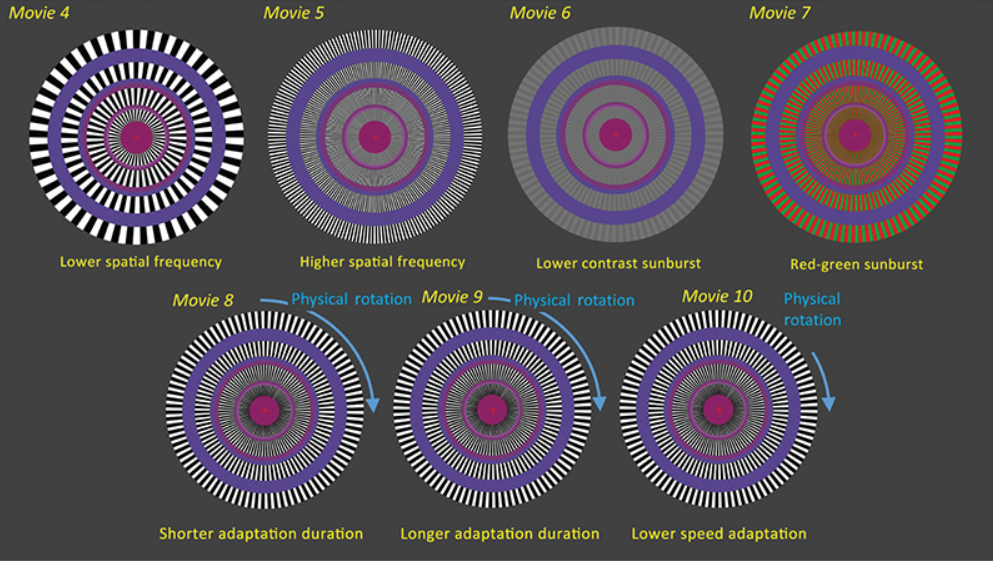
Ito, H., & Ding, L. (2022). The sunburst illusion. Journal of Illusion, 3, 8208. https://doi.org/10.47691/joi.v3.8208
|
Leviant, I. (1996). Does ‘brain-power’ make enigma spin? Proceedings of the Royal Society, London. Series B. Biological Science, 263, 997–1001. https://doi.org/10.1098/rspb.1996.0147
|
Mackay, D. (1957a). Moving visual images produced by regular stationary patterns. Nature, 180, 849–850. https://doi.org/10.1038/180849a0
|
MacKay, D. (1957b). Some further visual phenomena associated with regular patterned stimulation. Nature, 180, 1145–1146. https://doi.org/10.1038/1801145c0
|
Nishida, S. Y., & Sato, T. (1992). Positive motion after-effect induced by bandpass-filtered random-dot kinematograms. Vision Research, 32(9), 1635–1646. https://doi.org/10.1016/0042-6989(92)90156-D
|
Snowden, R. J., & Milne, A. B. (1997). Phantom motion aftereffects – Evidence of detectors for the analysis of optic flow. Current Biology, 7(10), 717–722. https://doi.org/10.1016/s0960-9822(06)00329-0
|
Sokoliuk, R., & VanRullen, R. (2013) The flickering wheel illusion: When α rhythms make a static wheel flicker. Journal of Neuroscience, 33(33), 13498–13504. https://doi.org/10.1523/JNEUROSCI.5647-12.2013
|
Tomimatsu, E., & Ito, H. (2016). Directional bias of illusory stream caused by relative motion adaptation. Vision Research, 124, 34–43. https://doi.org/10.1016/j.visres.2016.04.010
|
Tyler, C. W. (2022). The nature of illusions: A new synthesis based on verifiability. Frontiers in Human Neuroscience, 16, 875829. https://doi.org/10.3389/fnhum.2022.875829
|
Wade, N. J., Spillmann, L., & Swanston, M. T. (1996). Visual motion aftereffects: Critical adaptation and test conditions. Vision Research, 36(14), 2167–2175. https://doi.org/10.1016/0042-6989(95)00266-9
|
Wexler, M., Glennerster, A., Cavanagh, P., Ito, H., & Seno, T. (2013) Default perception of high-speed motion. Proceeding of the National Academy of Sciences of the United States of America, 110(17), 7080–7085. https://doi:10.1073/pnas.1213997110
|