Three-dot misalignment illusion and related new illusions: a rediscovery of Bouma and Andriessen’s (1968) oblique effect as a strong illusion
Abstract
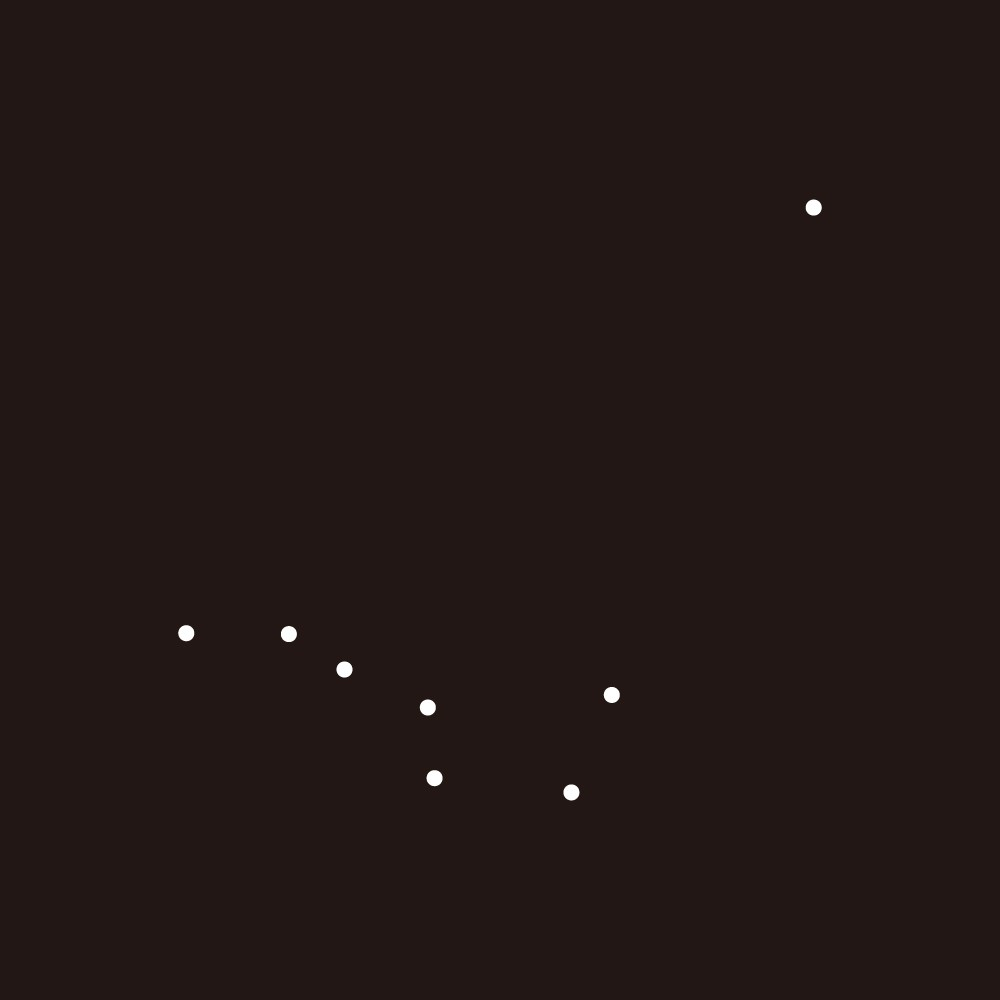
We describe a misalignment illusion observed in the spatial arrangement of three collinear dots, where two dots are proximally positioned while the third is distally located. The illusion manifests when the dots are oriented obliquely, creating a perceived deviation from linear alignment. In a near-vertical configuration with slight clockwise orientation, the extrapolated line connecting the proximal dots appears to pass laterally left of the superior distal dot. Conversely, in a near-horizontal arrangement with counterclockwise orientation, the perceived line trajectory falls inferior to the rightward distal dot. The illusion’s magnitude exhibits distance-dependency: it is absent when all three dots are equidistant but intensifies as the distance between the pair of dots and the remaining dot increases. While we independently discovered this perceptual phenomenon, subsequent literature review revealed its correspondence with the findings reported by Bouma and Andriessen (1968). Although historically categorized as tilt normalization or an oblique effect, we propose reconceptualizing this Bouma–Andriessen phenomenon as a distinct and robust misalignment illusion. Furthermore, we demonstrate that this illusion emerges even with abstract geometric features, such as circle centres or rectangle corners.
Downloads
References

This work is licensed under a Creative Commons Attribution-NonCommercial-NoDerivatives 4.0 International License.
Authors retain copyright of their work, with first publication rights granted to Journal of Illusion.