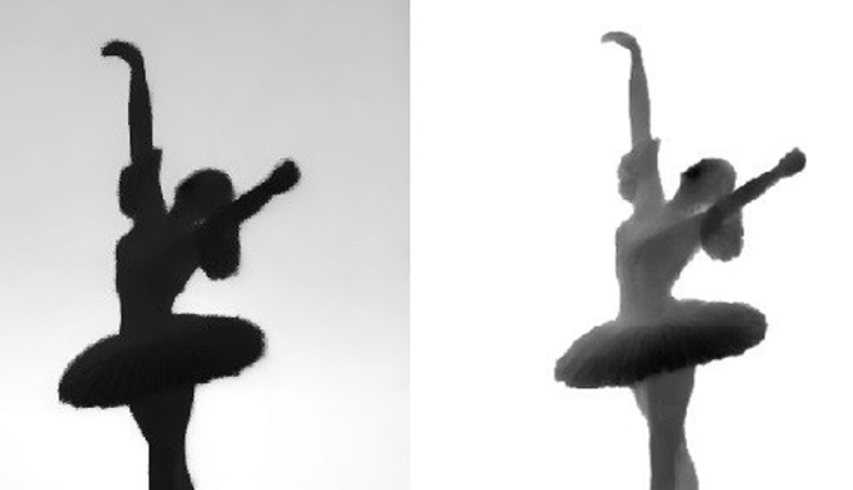
The static spin illusion

Authors

  • Saleeta Qadir Cognitive Computer Vision Lab, Visual Computing Erlangen, Friedrich-Alexander-Universität Erlangen-Nürnberg
  • Bernhard Egger Cognitive Computer Vision Lab, Visual Computing Erlangen, Friedrich-Alexander-Universität Erlangen-Nürnberg

DOI:

https://doi.org/10.47691/joi.v6.13468

Keywords:

static spin illusion, illusory motion, motion without movement, depth perception, phase modulation

Abstract

We propose the static spin illusion, an extension of the motion without movement effect to the third dimension. Static two-dimensional images can be converted into three-dimensional spinning motion illusions using phase-shifted filters and AI-generated depth estimations. By modulating the motion amplitude based on depth, the approach creates perception of three-dimensional movement while maintaining static object positioning. The technique combines second derivative Gaussian filters with their Hilbert transforms, enhanced by depth-dependent speed modulation using depth estimation. The resulting video leads to a perceived 3D rotation for a static person. The proposed illusion won the illusion of the year contest 2024. We share the code to reproduce our illusion and create own variants. The posting can be found here: https://illusionoftheyear.com/cat/top-10-finalists/2024/.

Downloads

Download data is not yet available.

References


Adelson, E.H. & Bergen, J.R. (1985). Spatiotemporal energy models for the perception of motion. Journal of the Optical Society of America, 2(2), 284–299. https://doi.org/10.1364/JOSAA.2.000284


Anstis, S.M. (1970). Phi movement as a subtraction process. Vision Research, 10(12), 1411–1430. https://doi.org/10.1016/0042-6989(70)90092-1


Anstis, S.M. & Rogers, B.J. (1975). Illusory reversal of visual depth and movement during changes of contrast. Vision Research, 15, 957–961. https://doi.org/10.1016/0042-6989(75)90236-9


Flynn, O. & Shapiro, A. (2018). The perpetual diamond: Contrast reversals along thin edges create the appearance of motion in objects. i-Perception, 9, 204166951881570. https://doi.org/10.1177/2041669518815708


Freeman, W., Adelson, E., & Heeger, D. (1991). Motion without movement. ACM SIGGRAPH Computer Graphics, 25(4), 27–30, https://doi.org/10.1145/127719.122721


Gregory, R.L., & Heard, P.F. (1983). Visual dissociations of movement, position, and stereo depth: some phenomenal phenomena. Quarterly Journal of Experimental Psychology, 35(Pt 1), 217–237. https://doi.org/10.1080/14640748308402127


Ke, B., Obukhov, A., Huang, S., Metzger, N., Daudt, R.C., & Schindler, K. (2024). Repurposing diffusion-based image generators for monocular depth estimation. In 2024 IEEE/CVF Conference on Computer Vision and Pattern Recognition (CVPR), 17–21 June 2024 (pp. 9492–9502). IEEE, Piscataway, NJ, USA.


Kitaoka, A. (2006). Configurational coincidence among six phenomena: a comment on van Lier and Csath´o (2006). Perception, 35(6), 799–806. https://doi.org/10.1068/p5319b


Mather, G., & Murdoch, L. (1999). Second-order processing of four-stroke apparent motion. Vision Research, 39(10), 1795–1802. https://doi.org/10.1016/S0042-6989(98)00191-6


Shadlen, M. & Carney, T. (1986). Mechanisms of human motion perception revealed by a new cyclopean illusion. Science, 232(4746), 95–97. https://doi.org/10.1126/science.3952502

Published

2026-11-27

How to Cite

Qadir , S., & Egger , B. (2026). The static spin illusion. Journal of Illusion, 6. https://doi.org/10.47691/joi.v6.13468

Issue

Section

Phenomenal reports